History of Shady Grove Church
The roots of Shady Grove Church reach back to the earliest days of Methodist worship in the New River Valley. In 1802, John Granade held what is believed to have been the first Methodist services west of the Alleghany Mountains in Virginia, gathering worshippers in the home of John and Hannah Crow Karr.
As settlement spread through the valley, religious life often centered around camp meetings. In 1815, the first camp meeting in this area was held near present-day Mechanicsburg. Three years later, in 1818, another gathering took place at Poplar Hill on an island across the creek from the site of the old fire hall, near the entrance to Green Hill Farm.
By this time, William Karr, son of John Karr, and his wife Elizabeth Bane Karr were living in the old Karr home nearby. Deeply devoted to their faith, they likely played an important role in organizing the 1818 camp meeting, held less than a quarter mile from their home. In the years that followed, they regularly opened their doors to circuit-riding preachers and occasionally hosted church services, helping sustain a growing Methodist presence in the community long before a church building stood on the site.
The island camp meeting grounds continued to draw worshippers. In 1821, circuit-riding preachers Jesse Green and Samuel Kennerly held services there that resulted in more than forty people making professions of faith, a remarkable number for a sparsely populated frontier community.
Religious activity in the region gained even greater momentum with the establishment of the Wabash Camp Meeting Grounds in 1834. For more than sixty years, Wabash served as one of the most important centers of worship and fellowship in the area, shaping the spiritual life of generations before its destruction by fire on September 1, 1896.
Before Shady Grove Church was built, local Methodists gathered in a log schoolhouse located just northwest of the present church. From 1840 until 1859, the humble structure served as a place of worship, education, and community gathering.
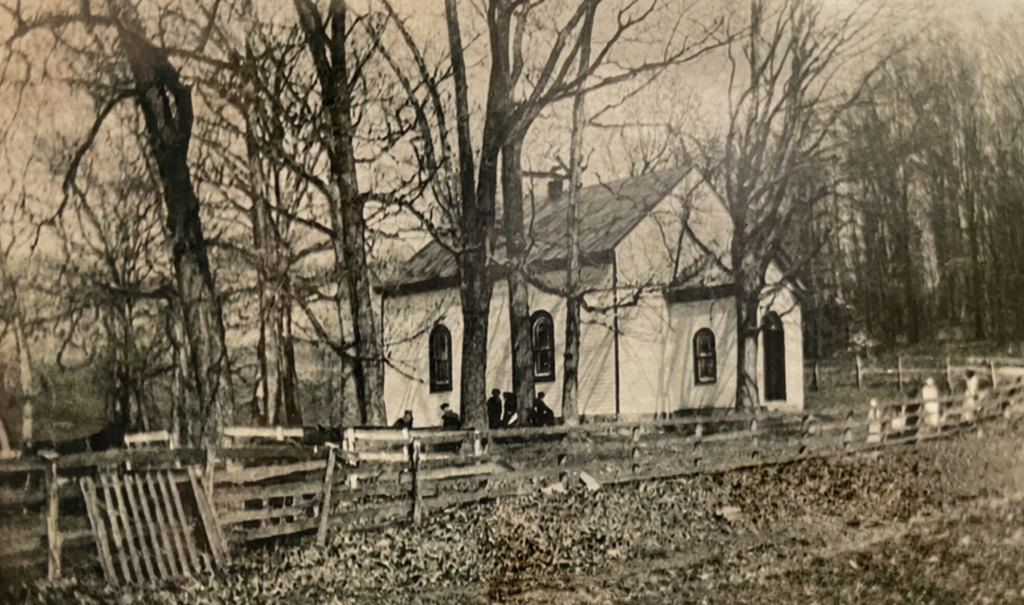
A permanent church home became possible on September 16, 1859, when Thomas Shannon Jr. and his brother-in-law, William Brown Allen, donated and deeded one acre of land for the church. Much of the land came from the Shannon family, while much of the lumber used in construction came from the Allen farm. The property was deeded to the trustees of the Methodist Episcopal Church South.
The first trustees of the church were William Haven Brown, Wiley Winton Eaton, John P. Johnston, Rev. Francis Farley, and Joseph Bane Carr. Also playing important roles in the founding of the congregation were Elizabeth Bane Carr and Charles King.
As the church grew, it became part of a larger network of congregations. In 1879, the Staffordsville Circuit was formed, consisting of Pleasant Hill, Thessalia, Easton’s Chapel, Sheffey Memorial, and Shady Grove. The first pastor appointed to the circuit was Rev. S. S. Grant, whose annual salary was $350.
One of Shady Grove’s most cherished treasures hangs in the sanctuary today. The brass chandelier traces its history to Virginia Allen Whiteaker, who grew up attending Shady Grove before moving to Bristol. In 1904, while attending State Street Methodist Church, she recognized the need for better lighting at her home church, which still relied on kerosene lamps mounted along the walls. Through her efforts, State Street Methodist donated its former chandelier to Shady Grove. Originally fueled by oil, it illuminated services for decades before being converted to electricity around 1940. More than a century later, it remains a visible link to the congregation’s past.
The church building itself has evolved over time. When originally constructed, the main entrance was located on the south side, and a rear balcony provided seating for enslaved people. In 1912, the south entrance was closed and a vestibule was added on the east side, creating the entrance arrangement familiar today.
Modern conveniences arrived gradually. In 1952, the church purchased its first piano, replacing the old pump organ that had accompanied worship for many years.
The congregation has also worked to preserve the memory of those who shaped its history. In 1999, the women of the Pearl Wright Society pieced a commemorative quilt that was quilted by Bertha Talbert of White Gate. Each piece bears the name of a woman who played a role in the life of the church, creating a lasting tribute to generations of faithful service.
In 2005, Shady Grove expanded its property through the purchase of two additional acres adjoining the church on the east side. Like many improvements before it, the acquisition was made possible through the generosity and commitment of church members.